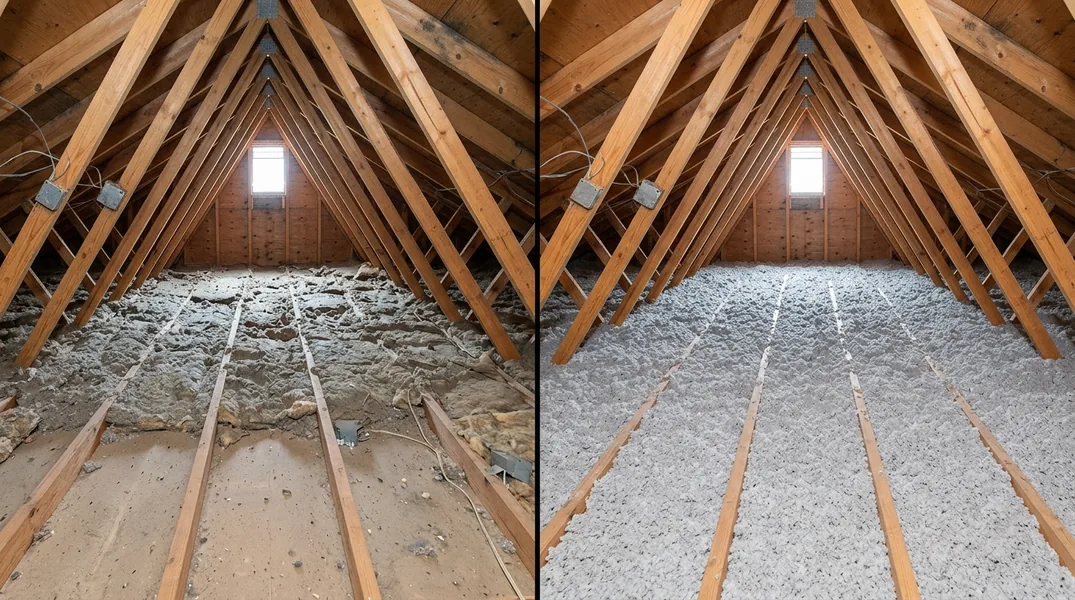
The Problem with Flattened Insulation in Older Ranch Homes
If you own a mid-century ranch home in Bloomington or elsewhere across Monroe County, your attic likely tells a familiar story. Decades of settling, moisture exposure, and foot traffic have compressed whatever insulation was installed when the house was built. What once provided an R-value of R-19 or R-21 has now flattened to barely R-5 or R-7, leaving your home vulnerable to energy loss and uncomfortable temperature swings.
Blown-in insulation and fiberglass batts were the standard choices in the 1950s and 1960s. While these materials served their purpose at the time, they suffer from a critical weakness: they compress over time. Gravity, vibration, and the weight of dust and debris all contribute to this degradation. Homeowners often discover the problem only when they notice rising utility bills or see ice dams forming on the roof during winter. By then, the insulation has already lost much of its effectiveness.
Spray Foam vs Blown In Insulation: Why One Lasts Longer
When comparing Attic Spray Foam Insulation to traditional blown-in insulation, the difference in longevity and performance becomes clear. Blown-in cellulose and fiberglass settle and compact over the years, especially in attics with temperature fluctuations and moisture exposure. In Bloomington's humid summers and cold winters, this compression happens faster than in more stable climates.
Spray foam, by contrast, expands to fill every cavity and crack, then hardens into a rigid or semi-rigid structure that resists settling. Unlike blown-in insulation, spray foam does not compress under its own weight or shift when the house settles. This permanence means the R-value you achieve on installation day remains virtually unchanged for decades. Additionally, spray foam creates an air-tight seal that blown-in insulation cannot match, eliminating convection losses that waste energy in older homes.
The practical outcome is simple: a blown-in attic may need replacement or supplementation within 10 to 15 years, while spray foam typically maintains its performance for 30 years or more. For homeowners tired of recurring energy bills and comfort problems, this durability justifies the upfront investment.
Spray Foam vs Fiberglass: Moisture Control and Air Sealing
Fiberglass batts, another common choice in mid-century homes, bring their own set of problems. Fiberglass is hygroscopic, meaning it absorbs and retains moisture. In attic spaces where humidity rises during summer or where roof leaks occur, fiberglass becomes a haven for mold growth and wood rot. Once saturated, fiberglass loses insulating value and can contribute to structural damage that far exceeds the cost of the original insulation.
Closed Cell Spray Foam Insulation offers superior moisture resistance. Its dense cellular structure prevents water absorption, and it actually helps protect the attic framing by creating a moisture barrier. This is especially valuable in older ranch homes where ventilation may be poor and condensation risk is high. Closed cell foam also provides structural reinforcement to roof decking, which can improve the home's resistance to wind and snow loads.
Open Cell Spray Foam Insulation is another option for homeowners seeking a less dense, more affordable alternative. While open cell foam is slightly more permeable than closed cell, it still outperforms fiberglass in terms of air sealing and long-term stability. The choice between closed and open cell depends on your specific attic conditions, budget, and local climate factors.
Spray Foam vs Cellulose: Performance in Monroe County's Climate
Cellulose insulation, made from recycled paper, is sometimes promoted as an eco-friendly blown-in option. While its recycled content is appealing, cellulose has significant drawbacks in humid climates like ours. Cellulose absorbs moisture readily and requires chemical fire retardants to meet building codes. Over time, these chemicals can off-gas, and the material itself becomes a breeding ground for mold if attic humidity rises above 60 percent.
Spray foam eliminates these concerns. It does not absorb moisture, does not support mold growth, and does not require ongoing chemical treatments. In Monroe County, where summer humidity can be substantial, this difference matters enormously. A cellulose-insulated attic may look fine on inspection day but develop hidden mold problems within a few years. Spray foam, by sealing the attic and controlling air flow, actually helps regulate humidity rather than exacerbating it.
The best insulation for attic spaces in older ranch homes is one that resists settling, repels moisture, and maintains its performance year after year. For homeowners in Bloomington and surrounding areas, spray foam consistently delivers these benefits in ways that blown-in cellulose, fiberglass, and other traditional materials simply cannot match.
Attic Spray Foam Insulation Near Me: When to Call a Professional
If your mid-century ranch home is showing signs of poor attic insulation, now is the time to act. Common warning signs include uneven room temperatures, ice dams in winter, higher-than-normal heating and cooling costs, and visible mold or moisture staining in the attic. These issues indicate that your existing insulation has failed and your home is losing conditioned air rapidly.
A professional assessment is the first step. Bloomington Spray Foam Insulation can evaluate your attic, measure current insulation levels, and identify air leaks that blown-in or fiberglass insulation cannot seal. We will recommend the best solution based on your home's specific needs, whether that is Closed Cell Spray Foam Insulation for maximum performance or Open Cell Spray Foam Insulation for a more budget-conscious approach. Contact us at (812) 318-1765 or request a free estimate today to see how spray foam can transform your attic's performance.
Attic Spray Foam Insulation Cost in Bloomington: What to Budget
The pricing for attic spray foam insulation varies based on attic size, current insulation conditions, and whether you choose closed cell or open cell foam. On average, homeowners in Monroe County can expect to invest between $1,500 and $4,500 for a complete attic spray foam project. This may seem higher than the cost of blown-in insulation, but the comparison is misleading when you factor in durability and performance.
Consider the total cost of ownership over 30 years. A blown-in attic might cost $800 to $1,500 initially but will likely need supplementation or replacement within 10 to 15 years, adding another $800 to $1,500 in costs. Spray foam, installed once, remains effective for the life of the home. When you add in energy savings from superior air sealing and reduced heating and cooling costs, spray foam often pays for itself within 7 to 10 years through lower utility bills. For a detailed breakdown of costs and financing options specific to your project, contact Bloomington Spray Foam Insulation at (812) 318-1765 or visit our website for more information on pricing.
Looking for a professional spray foam insulation contractor in Bloomington? Bloomington Spray Foam Insulation responds fast for all your spray foam insulation needs.
Get a Free Quote