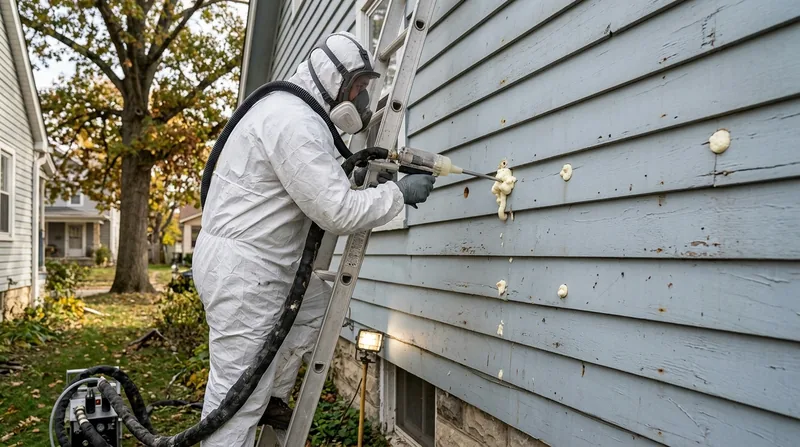




Wall & Injection Foam Insulation in Bloomington fills the closed cavities of older homes without removing drywall, a practical solution for the balloon-framed houses that line Prospect Hill and the neighborhoods near Indiana University where insulation was never installed in the first place. Bloomington's housing stock spans from century-old student rentals with open walls to mid-century brick ranches, and many of these homes sit in the path of the hot, humid summers and cold winters that drive moisture through walls in both directions. Injection foam seals those cavities from the inside, stopping air leakage and thermal loss without the disruption of demolition. If your home was built before 1980 and you can see daylight or feel drafts around outlets and baseboards, the walls are likely hollow. We help Bloomington homeowners close those gaps and recover the comfort and efficiency their homes should have had from the start.
Why Wall & Injection Foam Insulation Matters in Bloomington's Older Homes
Balloon-framed homes built in the early 1900s and through the 1970s across Bloomington and Ellettsville were constructed with vertical studs running the full height of the building, creating continuous cavities from basement to attic. These cavities trap air, which moves freely in winter and summer, carrying heat and cold right through the walls. The mixed-humid climate of southern Indiana makes this especially costly: summer heat drives moisture and heat inward through the walls, while winter cold reverses the flow, creating thermal stress and potential condensation inside the cavity. Standard fiberglass batts were rarely installed in these older walls during construction, and retrofitting them after the fact requires either removing drywall or drilling and filling from outside. Injection foam bypasses demolition entirely, filling the cavity in place through small holes that are later patched.
- Injection foam fills cavities without removing drywall, saving weeks of disruption and repair.
- The foam expands to contact all sides of the cavity, sealing air leaks that fiberglass batts cannot reach.
- Closed-cell foam resists moisture, critical in Bloomington's humid summers and damp crawl spaces that push moisture upward into walls.
- Open-cell injection foam is a lower-cost option for interior walls where moisture is not a primary concern.
- The process is complete in one day, with minimal mess and no weeks of drywall work afterward.
Older Bloomington homes with hollow walls lose comfort and efficiency every day the cavities stay empty. Injection foam closes that loss without tearing the house apart.
Local example: A 1920s home in Bryan Park near downtown Bloomington with exterior walls that were never insulated, drafty in winter and hot in summer, had injection foam installed in the main living area walls. The homeowner drilled access holes from inside, we filled the cavities, and the drywall was patched. No exterior work, no removal of plaster or siding. The result: warmer in winter, cooler in summer, and noticeably quieter. This is the injection foam job that Bloomington sees most often.
For more context on how spray foam works across different parts of your home, see our guide to closed-cell spray foam insulation, which is the foam type most suited to wall cavities in older homes.
How Wall & Injection Foam Insulation Works: The Bloomington Process
Injection foam starts with a site assessment. We identify which walls are candidates (exterior walls, walls between conditioned and unconditioned space, or walls that face outside), confirm the cavity is clear of obstructions, and determine whether open-cell or closed-cell foam is the right choice based on moisture risk and budget. Bloomington's damp basements and humid crawl spaces mean that exterior and rim-adjacent walls almost always call for closed-cell foam; interior partition walls may be suitable for open-cell. Once the method is set, we drill access holes (typically 1.5 inches) at intervals along the wall, insert the injection tube, and pump foam until the cavity is full. The foam expands slightly and hardens in place, then we patch the holes with drywall or wood plugs and finish them to match. The entire process is quiet and contained, with no removal of existing materials.
- We assess the wall cavity with a borescope or by drilling a small test hole to confirm it is clear and measure its depth.
- We select open-cell or closed-cell foam based on the wall's location, exposure to moisture, and your budget.
- We drill access holes spaced 16 to 24 inches apart, depending on cavity width and foam flow characteristics.
- We inject foam under pressure, filling the cavity from bottom to top to displace air and ensure complete contact.
- We patch all access holes with drywall, wood, or spackle, and finish them to blend with the wall.
- We allow the foam to cure per manufacturer specifications before the wall is painted or disturbed.
The entire job is complete in a single day for a typical room, with re-entry safe after 24 to 48 hours depending on foam type and ambient temperature.
Bloomington example: A 1950s brick ranch in Mooresville with an uninsulated exterior wall facing north had injection foam installed in the living room. The wall had been cold to the touch in winter, and condensation sometimes formed on the interior drywall. After injection foam, the wall surface temperature rose noticeably, and the condensation stopped. The homeowner appreciated that the work was done from inside, with no disruption to the brick exterior or the landscaping outside.
For complementary work such as rim joist sealing or crawl space insulation, which often go hand-in-hand with wall cavity work in older Bloomington homes, see our rim joist and band joist foam service.
Wall & Injection Foam Methods: Comparing Your Options
| Approach | Description | Best For |
|---|---|---|
| Closed-Cell Injection Foam | High-density foam (typically 2 to 3 lbs/cu ft) that expands minimally and hardens quickly, creating an air and moisture barrier in the cavity. | Exterior walls, walls below grade or adjacent to crawl spaces, and any cavity where moisture resistance is critical in Bloomington's humid climate. |
| Open-Cell Injection Foam | Lower-density foam (typically 0.5 to 1 lb/cu ft) that expands more and is permeable to vapor, allowing the wall to dry if moisture enters. | Interior partition walls, walls in conditioned space, and cost-conscious retrofits where the cavity is not exposed to standing moisture or outdoor weather. |
| Low-Pressure Injection | Foam applied at lower pressure (typically 10 to 15 psi) to minimize stress on framing and drywall in older, fragile structures. | Historic or century-old homes in Prospect Hill and near Indiana University where framing may be weakened by age or previous water damage. |
| High-Pressure Injection | Foam applied at higher pressure (20 to 30 psi) to ensure complete cavity fill and force foam into tight spaces and around obstructions. | Solid construction homes (post-1970s) where framing is intact and cavities are deep or irregular, or where maximum R-value is the priority. |
Wall & Injection Foam Insulation Cost in Bloomington: What to Expect
Injection foam pricing in Bloomington typically starts at around $2 per square foot of wall cavity filled, though the final cost depends on several factors specific to your home and the scope of work. The primary cost drivers are the depth and length of the cavities being filled (older balloon-frame homes may have 2x6 or even 2x8 cavities, while some mid-century homes have 2x4 walls), the type of foam selected (closed-cell costs more than open-cell), the number of access holes required, and the complexity of patching afterward. Accessibility also matters: walls in basements or crawl spaces may require additional setup time or equipment. A typical single-room project in a Bloomington home runs between $800 and $2,500 depending on wall area and foam type; whole-house jobs are priced per cavity or per linear foot of wall. The best way to understand your actual cost is to request a free written estimate, which will include the R-value, foam type, thickness, and total board-foot volume so you can compare accurately.
We also recommend getting 2 to 3 estimates from different contractors. This protects you against underpriced work (which often means skipped steps, poor ventilation during cure, or inadequate thickness) and helps you understand what a fair price includes. A solid estimate will specify the foam type (open or closed cell), the R-value per inch, the target thickness, the number of access holes, and a warranty on the installation workmanship. If an estimate is missing any of these details, ask for them before you decide.
For detailed pricing on other insulation services that may complement wall injection, such as attic or crawl space foam, visit our pricing page.
Wall & Injection Foam Insulation Near Me: What Bloomington Homeowners Should Know When Hiring
When you are ready to hire a spray foam contractor for wall injection work in Bloomington, Ellettsville, Martinsville, or the surrounding areas, there are a few key things to verify before you book. First, confirm that the contractor is fully insured and can provide a certificate of insurance on request; this protects you if anything goes wrong during the work. Second, ask for references from recent jobs in your area and actually call them, especially if the contractor is new to you. Third, request a written estimate that includes the foam type, R-value, thickness, access hole locations, and patching plan. Fourth, ask about the contractor's permitting process. In Bloomington, injection foam work into existing walls does not typically require a building permit, but if you are unsure, the contractor should help you verify what applies to your address by contacting the City of Bloomington Planning Department or your local building official. Finally, confirm the cure time and re-entry window; honest contractors specify 24 to 48 hours before normal use, and they explain why: the foam needs time to harden and off-gas safely in a ventilated space.
- Verify the contractor is fully insured with a current certificate of insurance provided in writing.
- Ask for at least two references from wall injection jobs completed in the past 12 months in Bloomington or nearby cities.
- Request a detailed written estimate that specifies foam type, R-value per inch, target thickness, and total board feet.
- Confirm the contractor understands local permitting requirements and will help you navigate them if needed.
- Ask about mechanical ventilation during foam cure and the re-entry window before the space is occupied normally.
- Verify that access holes will be properly patched and finished, not left as temporary plugs.
A reputable local contractor will answer all of these questions clearly and provide documentation. If a contractor avoids these topics or gives vague answers, move on to the next estimate.
Ready to get started? Contact us for a free estimate at (812) 318-1765. We respond within 24 hours and can walk you through the process for your specific home and walls.
Wall & Injection Foam Insulation in Bloomington: Pricing Guide
| Service | Price | Details |
|---|---|---|
| Single-room wall injection (interior) | Starting at $2/sq ft | Open-cell foam in interior partition walls, 2x4 cavities, standard access and patching |
| Exterior wall injection (closed-cell) | Starting at $2.50/sq ft | Closed-cell foam in exterior walls or walls adjacent to unconditioned space, moisture-resistant barrier included |
| Full-house wall retrofit | On estimate | Multiple rooms and mixed cavity depths require on-site assessment to determine total board feet and final cost |
| Historic or fragile framing | On estimate | Low-pressure injection in century-old homes near Indiana University and Prospect Hill, extra care and testing required |
| Travel and site visit | Included | No separate mileage or travel fee for jobs in Bloomington and surrounding Monroe County service areas |
| Free written estimate | No charge | Detailed estimate with R-value, foam type, thickness, and board-foot volume, response within 24 hours |
Indicative pricing, the exact cost depends on square footage, finish, and site access. Free personalized estimate within 24h at (812) 318-1765.


