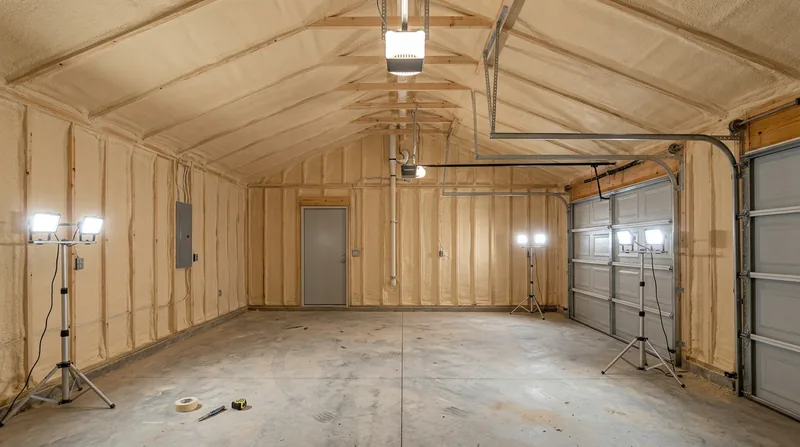




Garage spray foam insulation in Bloomington turns a seasonal liability into a usable space. Garages in Bloomington and across Monroe County swing between humid summer heat that bakes uninsulated ceilings and winter cold snaps that freeze rim joists and band boards. Without insulation, your garage becomes a thermal sieve, pulling conditioned air from the house and driving heating and cooling costs upward. We spray foam garage walls and ceilings to create a thermal boundary that holds temperature through both seasons, making the space functional for storage, work, or bonus living without the energy penalty.
Why Garage Insulation Matters in Bloomington's Climate
Bloomington's mixed-humid climate creates two distinct failure modes in uninsulated garages. Summer brings sustained heat and humidity that drive moisture inward through walls and ceilings, while winter cold snaps reverse that flow and expose gaps in rim joists and band boards. An uninsulated garage attached to a conditioned home becomes a thermal leak that forces your HVAC system to work harder, especially in winter when cold air infiltrates through the garage into living spaces above and adjacent. Spray foam seals the envelope completely, stopping air leakage and condensation at the source.
- Spray foam blocks air leakage through rim joists and band boards that separate garage from basement or crawl space.
- Closed cell foam resists moisture infiltration in both directions, critical during Bloomington's humid summers and winter thaw cycles.
- A sealed garage ceiling prevents warm air from escaping upward in winter and heat from radiating downward in summer.
- Foam-insulated garage walls eliminate cold spots that encourage condensation on metal shelving and stored items.
The result is lower utility bills, less strain on your home's HVAC system, and a garage that stays above freezing in winter and below ambient in summer.
Key info: Bloomington and Ellettsville garages attached to homes lose more heat through the common wall and ceiling than through exterior walls. Spray foam to the rim joist and ceiling is the single highest-return insulation upgrade after the attic.
How We Insulate Garages in Bloomington: Step by Step
Garage spray foam insulation begins with a site walk to identify thermal weak points: rim joists where garage meets foundation, band boards above the foundation wall, the common wall shared with the house, and the ceiling. We assess existing insulation, moisture conditions, and structural integrity before recommending closed cell or open cell foam. Once you approve the estimate, we schedule the work, seal the space to contain spray, and apply foam in controlled passes to achieve the specified R-value and thickness. Mechanical ventilation runs during cure, and we provide a re-entry window of 24 to 48 hours before the space is safe for normal use.
- We inspect the garage structure, existing insulation, and moisture conditions to determine the best approach.
- We seal the space and protect surrounding areas from overspray using tarps and temporary barriers.
- We spray closed cell or open cell foam to the ceiling and walls in controlled passes, monitoring thickness and coverage.
- We run mechanical ventilation throughout the cure period and confirm proper drying before re-entry.
- We remove temporary protection and walk you through the finished job and warranty terms.
The entire process typically takes one to two days, depending on garage size and foam type.
Example: A two-car garage in Bloomington with a 400-square-foot ceiling and 300 square feet of rim joist receives closed cell foam to R-20 on the ceiling and R-15 on the rim. The job runs 4 to 6 hours, with re-entry allowed after 24 hours. Open cell foam on the same space costs less upfront but offers lower R-value per inch and less moisture resistance, making it a secondary choice in Bloomington's humid climate.
See our guide to closed cell spray foam insulation in Bloomington for technical details on foam type selection.
Garage Spray Foam Methods: Closed Cell vs. Open Cell
| Approach | Description | Best for |
|---|---|---|
| Closed Cell Spray Foam | High-density foam that cures rigid and air-tight. Achieves R-6 to R-7 per inch. Resists moisture and vapor diffusion. Requires skilled application to avoid over-packing and thermal stress on framing. | Garages in humid climates, rim joists, band boards, and spaces where moisture control is critical. Standard choice in Bloomington. |
| Open Cell Spray Foam | Lower-density foam that cures soft and slightly flexible. Achieves R-3.5 to R-3.8 per inch. Allows vapor diffusion and drying. Lower material cost but requires thicker application for equivalent R-value. | Detached garages where moisture risk is lower, or as a cost-conscious ceiling-only upgrade in dry storage spaces. Less common in Bloomington due to climate. |
| Rim Joist and Band Board Sealing | Closed cell foam applied specifically to the perimeter band and rim where garage meets foundation. Typically R-15 to R-20 in 2 to 3 inches. Stops infiltration at the thermal boundary. | Every attached garage in Bloomington. This is the single highest-return upgrade and the first priority in a phased approach. |
| Ceiling Only (Partial Upgrade) | Spray foam applied to the garage ceiling only, leaving walls uninsulated. Captures the biggest heat loss path and reduces cost. Works best when rim joist is already sealed or when budget is constrained. | Garages where the ceiling is the dominant thermal leak and walls are adequately insulated or budget limits the scope. Often a Phase 2 after rim joist work. |
Closed cell is the standard in Bloomington garages because humidity and seasonal moisture swings demand vapor control. Open cell is occasionally appropriate in detached, dry storage spaces, but the mixed-humid climate makes it the secondary choice.
Garage Spray Foam Insulation Cost in Bloomington: What to Expect
Garage spray foam insulation in Bloomington starts at $1,200 for a rim joist and band board seal on a single-car garage, and typically runs $2,500 to $4,500 for a full two-car garage including ceiling and walls. The final cost depends on the square footage of insulated surface, foam type (closed cell versus open cell), desired R-value, and site access. A two-car garage with a 400-square-foot ceiling and 300 square feet of rim joist at R-20 closed cell runs roughly $3,200 to $3,800, while open cell on the same space costs $2,200 to $2,800. Scope, not size alone, drives the price: a rim joist seal is a smaller job than a full ceiling, and a full envelope (ceiling plus walls plus rim) is the largest.
Factors that affect your final estimate include proximity to the house (attached garages cost more because the common wall and rim joist are critical thermal boundaries), existing insulation that must be removed, moisture conditions requiring substrate preparation, and local labor rates. We provide a written estimate with R-value and thickness specs so you know exactly what you are paying for. Travel is included across Bloomington and the surrounding service area, with no separate mileage fee.
The best way to understand your cost is to request a free estimate. We respond within 24 hours and walk you through the options. Getting 2 to 3 estimates from different contractors is smart practice and helps you spot low-ball offers that skip mechanical ventilation or promise immediate re-entry, both signs of poor installation.
See our full pricing overview for additional service costs and financing options.
Garage Spray Foam Insulation Near Me: What Bloomington Homeowners Should Know When Hiring
Hiring a spray foam contractor is a significant decision because poor installation creates odor, off-gassing, and thermal failure that is expensive to correct. The spray foam trade includes both local independent shops and national franchises, and both also include rig-and-run crews that spray a job in an afternoon and disappear when the smell will not go away. The honest differentiator is installation discipline: correct drum temperature, controlled thickness per pass, the manufacturer ratio, and mechanical ventilation during cure. Ask any contractor whether they run mechanical ventilation during cure and what re-entry window they guarantee. If they promise immediate re-entry or skip ventilation, walk away.
When evaluating contractors, request a written estimate that includes R-value and thickness specs, not just a price. Verify that the contractor is fully insured and ask for proof of coverage. Check references from jobs completed in Bloomington or nearby, and ask those homeowners about odor, curing time, and whether the space performs as promised. Understand your local building code by contacting the Bloomington building department or your city's code official. Permitting requirements vary by jurisdiction within Greater Bloomington, and there is no reciprocity between cities, so verify what applies at your address. If your garage is in a homeowners association, check your architectural guidelines to confirm that insulation work is permitted.
The best contractors in Bloomington have local roots, a verifiable track record, and a willingness to explain why they recommend one foam type over another. We have been in business since 2014 and are fully insured. Contact us for a free estimate, and we will walk you through the process with no obligation.
Garage Spray Foam Insulation in Bloomington: Pricing Guide
| Service | Price | Details |
|---|---|---|
| Rim Joist and Band Board Seal | Starting at $1,200 | Closed cell foam to R-15 on the perimeter band where garage meets foundation. Single-car garage, typical access. Highest-return upgrade. |
| Two-Car Garage Ceiling | Starting at $1,800 | Closed cell foam to R-20 on 400 square feet of ceiling. Does not include rim joist or walls. Partial upgrade for budget-conscious homeowners. |
| Full Two-Car Garage (Ceiling, Walls, Rim) | Starting at $3,200 | Closed cell foam to R-20 ceiling and R-15 walls and rim joist. Complete thermal envelope. Most common scope in Bloomington. |
| Open Cell Garage Insulation | Starting at $2,200 | Lower cost than closed cell but requires thicker application for equivalent R-value. Best for detached, dry storage spaces only. |
| Complex or Large Scope | On estimate | Garages with moisture issues, existing contaminated insulation, or unusual geometry require site inspection before pricing. |
| Free Estimate and Consultation | Free | Response within 24 hours at (812) 318-1765. Written estimate with R-value and thickness specs. No obligation to book. |
Indicative pricing, the exact cost depends on square footage, finish, and site access. Free personalized estimate within 24h at (812) 318-1765.


