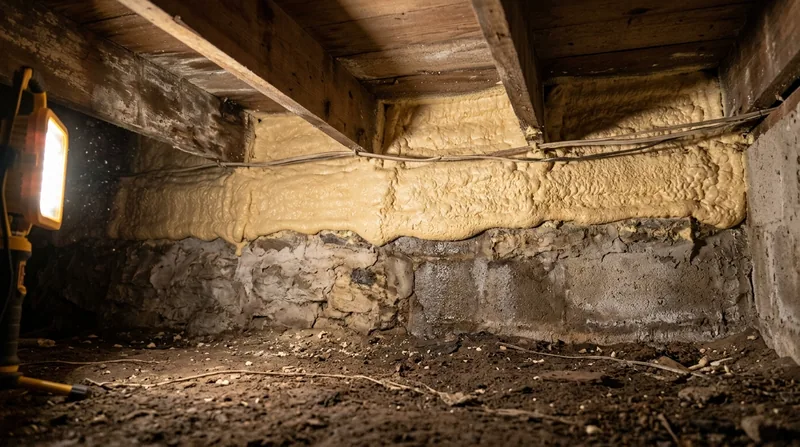




Closed cell spray foam insulation in Bloomington delivers rigid strength and moisture resistance that matters on wooded lots over limestone bedrock where standing water collects in crawl spaces and basements. The mixed-humid climate of Monroe County drives moisture inward through walls during hot, humid summers, then reverses the flow when winter cold snaps hit, making air sealing and vapor control essential. Century-old homes in Prospect Hill and near Indiana University, mid-century brick ranches across the county, and newer two-story builds toward Ellettsville all face the same pressure: damp crawl spaces, drafty rim joists, and attics that bake in summer while cold air leaks through in winter. Closed cell foam adds the rigid structure and moisture barrier that fiberglass cannot match, especially in retrofit work where space is tight and moisture is the enemy. We have been serving Bloomington since 2014, and we understand the specific failure modes that drive insulation decisions here.
Why Closed Cell Spray Foam Matters in Bloomington's Older and Transitional Housing Stock
Bloomington's housing mix spans converted student rentals with balloon framing and open dirt crawl spaces, to brick ranches with flattened attic insulation, to newer homes with tight wall cavities and bonus rooms over garages. Closed cell foam addresses the structural and moisture challenges that generic insulation cannot. It resists the standing moisture that collects under wooded lots, seals air gaps in rim joists and band joists where cold drafts enter, and adds rigidity to walls in retrofit work where you cannot tear down and rebuild.
- Closed cell foam adheres to rim joists and band joists, blocking the cold air leaks that drive winter heating bills in older Bloomington homes.
- The rigid foam adds structural bracing to walls and crawl space headers, critical in homes with settling foundations over limestone bedrock.
- It resists moisture absorption in damp crawl spaces and basements, unlike fiberglass that flattens and loses R-value when wet.
- Closed cell foam can be sprayed over existing insulation in attics where removal is not practical, adding R-value without tearing out failed batts.
- The air seal created by closed cell foam reduces the load on HVAC systems, cutting the work they must do to condition the home.
Each of these factors adds up to longer-lasting performance and lower operating costs in the Bloomington climate.
Key info: Bloomington's building code and local permitting rules govern attic ventilation, ignition barriers, and thermal barriers on spray foam work. Always check with your local building department before starting any spray foam project, as rules vary between Bloomington proper, Ellettsville, Martinsville, and surrounding towns. We help homeowners navigate what applies at your address.
For more detail on how closed cell foam compares to open cell options, see our guide to open cell spray foam insulation in Bloomington.
How We Install Closed Cell Spray Foam Insulation: Process and Technique in Bloomington
Closed cell spray foam installation is a precision process. We spray the foam in controlled passes, monitor drum temperature and chemical ratio, and ensure mechanical ventilation during cure. The substrate must be dry, sound, and free of contamination, or we do not spray. Re-entry is not safe for twenty-four to forty-eight hours after the last pass, and we make that timeline clear before we start.
- We inspect the area, identify air leaks and moisture sources, and determine whether the substrate is suitable for foam.
- We protect adjacent areas, set up mechanical ventilation, and establish a containment zone to manage overspray and cure-time fumes.
- We spray closed cell foam in multiple thin passes, building thickness to the design R-value and monitoring coverage as we go.
- We allow the foam to cure fully, maintaining ventilation and restricting re-entry until the manufacturer cure window has passed.
- We inspect the finished application, verify thickness and coverage against the design spec, and walk through the re-entry and use guidelines with you.
This methodical approach prevents the problems that plague quick-and-cheap spray foam jobs: uneven thickness, poor ratio, inadequate cure time, and occupants re-entering too soon and complaining about smell.
Local example: A crawl space retrofit in Martinsville required closed cell foam on rim joists, band joists, and the header beam where moisture was seeping in from the wooded lot above. We sealed the rim joist with 2 inches of closed cell, sprayed the header, and left the crawl space floor open for future encapsulation work. The homeowner waited forty-eight hours before re-entry, and the moisture problem stopped.
If your project involves existing insulation removal first, see our insulation removal service page for details on how we handle attic and wall cavity clearance before foam installation.
Closed Cell Spray Foam Applications and Methods
| Application | Description | Why Closed Cell Works Here |
|---|---|---|
| Rim Joist and Band Joist | 1 to 2 inches of closed cell foam sprayed on the exposed rim, sealing air leaks and providing rigid bracing in older homes with settling foundations. | Closed cell resists moisture from damp crawl spaces, adheres firmly to concrete and rim board, and adds structural support where deflection is a concern. |
| Crawl Space Insulation | Closed cell spray foam applied to crawl space headers, band joists, and walls in damp spaces where fiberglass fails. | Standing moisture is the rule in Bloomington crawl spaces on wooded lots; closed cell resists saturation, does not flatten, and maintains R-value even if humidity spikes. |
| Wall Cavity Retrofit | Injection foam or spray foam applied to existing wall cavities without removing drywall, adding R-value and air sealing in pre-1980 homes. | Closed cell injection foam fills cavities completely, resists moisture migration in the mixed-humid climate, and does not require demolition of walls. |
| Metal Building and Garage | Closed cell foam sprayed on the interior of metal roof decks and walls to control condensation and add insulation value. | Metal buildings sweat in humid summers and frost in cold winters; closed cell foam creates a thermal break and vapor barrier that prevents condensation on steel. |
| Sealed Attic Retrofit | Closed cell spray foam applied to the underside of the roof deck, creating an unvented attic that resists hot-summer and cold-winter air leaks. | Sealed attics with closed cell foam eliminate the hot-attic problem in summer and reduce winter heat loss; the rigid foam braces roof rafters and resists moisture from interior humidity. |
Closed Cell Spray Foam Insulation Cost in Bloomington: What to Expect
Closed cell spray foam pricing starts at approximately $1.20 per board foot for standard rim joist and crawl space work in the Bloomington area. The final cost depends on several factors: the depth and coverage area you need, the accessibility of the space, whether the substrate is dry and clean, and the complexity of the layout. A simple rim joist sealing job on a single-story home near Bloomington might run $800 to $1,500; a full crawl space retrofit with headers and walls can range $2,500 to $6,000 or more. Sealed attic work on a two-story home with bonus rooms runs higher because of the roof area involved.
The best way to get an accurate price is to request a free, no-obligation estimate. We measure on site, specify the R-value and thickness you need, and give you a written quote with all the details. We recommend getting 2 to 3 estimates from local contractors so you can compare specifications, not just prices. A low bid with no R-value spec and no thickness detail is a red flag, not a bargain.
For a full breakdown of pricing across all our services, see our pricing page.
What to Look for When Hiring a Spray Foam Contractor Near Bloomington
The spray foam insulation market in Greater Bloomington includes local independent shops, national franchises, and out-of-state crews that roll through town in a trailer and disappear when problems arise. Hiring the right contractor matters because spray foam is permanent, and a bad installation is expensive to fix. Here is what to check before you sign:
- Verify that the contractor is fully insured and can provide a current certificate of insurance covering spray foam application.
- Ask for written estimates that include the R-value, thickness in inches, and coverage area so you can compare apples to apples.
- Check references from recent jobs in Bloomington, Ellettsville, or Martinsville, and ask specifically about smell, cure time, and any issues after installation.
- Confirm that the contractor understands local permitting rules for your city and will help you navigate thermal barrier and ventilation requirements.
- Do not accept a price estimate over the phone; closed cell foam work requires a site visit to assess the substrate and plan the installation.
- Ask about the cure time and re-entry window; any contractor promising immediate re-entry is cutting corners on safety and quality.
- If your home is in an HOA community, verify that exterior work on metal buildings or garages complies with architectural rules before you start.
These steps protect you and help you identify a contractor who takes the work seriously.
When you are ready to move forward, contact us for a free estimate at (812) 318-1765. We respond within 24 hours and will walk you through the process, answer your questions, and give you a written spec before any work begins.
Closed Cell Spray Foam Insulation in Bloomington: Pricing Guide
| Service | Price | Details |
|---|---|---|
| Rim Joist and Band Joist Sealing | Starting at $1.20/board ft | Typical rim joist retrofit 800 to 1500 dollars depending on linear footage and crawl space access difficulty |
| Crawl Space Insulation | Starting at $1.20/board ft | Full crawl space retrofit with headers and walls runs 2500 to 6000 dollars depending on square footage and moisture conditions |
| Wall Cavity Retrofit and Injection Foam | Starting at $1.20/board ft | Wall cavity injection work priced per square foot of wall area treated, typically 1200 to 3500 dollars per room depending on cavity size |
| Sealed Attic and Roof Deck Retrofit | On estimate | Sealed attic work requires site measurement of roof area and existing insulation, typically 3500 to 12000 dollars for two-story homes |
| Travel and Mobilization | Included | No separate travel fee or mileage charge in Bloomington and surrounding Monroe County service areas |
| Free Estimate | No charge | Written estimate with R-value and thickness specs, response within 24 hours at 812 318-1765, no obligation to book |
Indicative pricing, the exact cost depends on square footage, finish, and site access. Free personalized estimate within 24h at (812) 318-1765.


