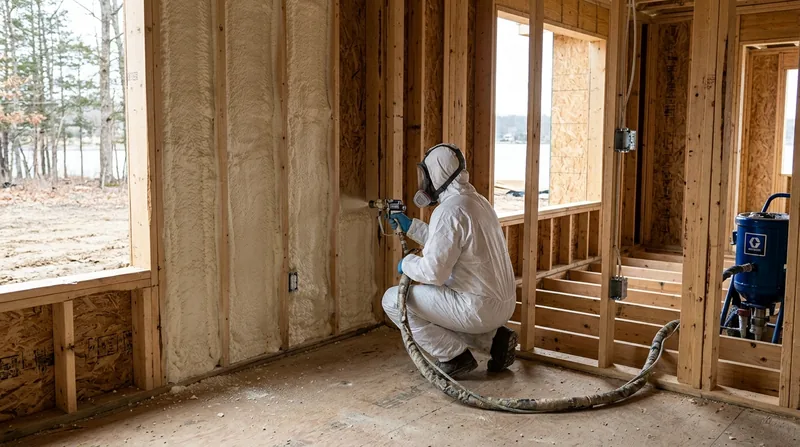




New commercial and residential construction across Bloomington and toward Ellettsville moves fast, and spray foam insulation has to be in place before drywall, mechanical rough-in, and final inspection. Commercial and new construction spray foam in Bloomington means closed cell or open cell foam sprayed to the energy code that applies at your address, with R-value and thickness documented in writing before work begins. The mixed-humid climate of southern Indiana, combined with Bloomington's wooded terrain over limestone bedrock and the region's hot, humid summers followed by cold winters, demands envelope integrity from day one. Whether you are building a two-story home near Lake Monroe, a commercial shell in Ellettsville, or a metal-frame retail space in Mooresville, the spray foam goes up when the structure is open, the framing is set, and utilities are routed. We spray walls, attics, and rim joists to code before final inspection, and we document every pass with R-value and thickness specifications so your builder and the building official have what they need.
Why Commercial and New Construction Spray Foam Matters in Bloomington
Bloomington's building code requires specific R-values and air sealing performance in attics, walls, and rim joists depending on your address and the energy code in effect. Spray foam applied during framing, before drywall, before ductwork is buried, before final inspection, delivers continuous insulation and air sealing in one pass. This is not a retrofit; it is a performance baseline built into the structure from the start. A builder who waits until after framing is complete to address air leaks or relies on batts and blown-in insulation alone will face callbacks and failed blower-door tests. Spray foam eliminates that risk because it fills every cavity, every corner, and every penetration in a single application.
- Continuous insulation eliminates thermal bridging through studs, joists, and plates.
- Closed cell foam adds structural rigidity and can improve racking resistance in high-wind zones.
- Open cell foam is less dense, lower cost, and sufficient for most new construction attics in Monroe County.
- Air sealing during framing prevents punch-list delays and failed energy code inspections.
- Written R-value and thickness documentation satisfies the building official before final approval.
A builder who schedules spray foam during framing avoids the cost and schedule hit of retrofitting insulation after drywall is hung.
Local example: New construction in Ellettsville and toward Lake Monroe typically frames between May and July, when spray foam contractors are busiest. Scheduling early with your insulation contractor ensures your crew gets a firm date and avoids construction delays. Check with your local building department in Bloomington, Ellettsville, or Martinsville to confirm the energy code and R-value requirements for your specific project address.
How We Spray Commercial and New Construction Foam in Bloomington: Step by Step
Spray foam installation during new construction is scheduled around your framing and mechanical timeline. We arrive when walls are up, roof decking is in place (if applicable), and utilities are routed so we can spray walls, attics, and rim joists without damaging electrical or plumbing. Our crew sets up temporary mechanical ventilation, sprays the foam to the specified thickness in controlled passes, and documents every section with measurements and R-value calculations. Once the foam cures, typically within 24 to 48 hours, your crew can move to drywall, mechanical finishing, and final inspection. The entire process is coordinated with your builder's schedule and the building official's inspection requirements.
- We review your plans, energy code requirements, and R-value targets for attics, walls, and rim joists.
- We coordinate a spray date that fits your framing and mechanical schedule.
- We set up temporary mechanical ventilation and establish a work perimeter on site.
- We spray foam to the specified thickness in multiple controlled passes, checking ratio and temperature on every drum.
- We document R-value and thickness for every section in writing with measurements and photos.
- We confirm cure time and re-entry clearance with your builder before drywall or mechanical rough-in resumes.
This structured approach means no surprises at final inspection and no rework because the insulation was undersized or missed critical areas.
Example project: A new two-story residential build in Mooresville frames in June, with drywall scheduled for July. We spray attics and rim joists in early July after roof decking and before ceiling joists are insulated. The builder receives a written report showing R-21 closed cell in the rim joist, R-38 open cell in the attic, and full air sealing around all penetrations. Final inspection passes because the documentation is complete and the work meets code. For more on how air sealing complements spray foam, see our dedicated air sealing page.
Spray Foam Methods for Commercial and New Construction
| Approach | Description | Best for |
|---|---|---|
| Closed Cell Spray Foam | High-density foam with R-6 to R-7 per inch, vapor-impermeable, adds structural strength. | Rim joists, band joists, metal building cavities, and sealed roof decks where moisture control and rigidity matter most. |
| Open Cell Spray Foam | Lower-density foam with R-3.5 to R-4 per inch, vapor-permeable, allows drying, quieter application. | Attics in new construction, interior walls, and sound-dampening applications where cost and breathability are priorities. |
| Wall Cavity Spray Foam | Closed or open cell foam sprayed into stud cavities during framing, fills every gap and reduces air infiltration. | New construction walls, commercial shells, and energy code compliance in the mixed-humid climate of southern Indiana. |
| Attic and Roof Deck Spray | Foam applied to roof decking or attic floor, sealed or vented per code, with R-value documentation. | New residential and commercial construction, bonus rooms, and vaulted ceilings where attic insulation must perform under load. |
Commercial and New Construction Spray Foam Cost in Bloomington: What to Expect
Spray foam pricing for new construction depends on the scope of work, the foam type (closed cell or open cell), and the R-value target set by your energy code and builder. A free commercial estimate is the only honest starting point because spray foam is measured at the job site in board feet, and board feet depend on the cavity dimensions, wall length, attic floor area, and rim joist perimeter. We document the estimate in writing with R-value and thickness specifications so you and your builder know exactly what you are paying for before work begins.
Factors that affect the total cost include the foam type selected, the total square footage of walls and attics, the complexity of penetrations and mechanical routing, and site access for our equipment. A simple attic spray in a single-story ranch costs less than a two-story build with vaulted ceilings, multiple roof planes, and extensive wall cavity work. Closed cell foam costs more per board foot than open cell because it delivers higher R-value and structural benefits, but for a straightforward attic in new construction, open cell is often the right choice and the better value. We are transparent about these trade-offs and recommend the foam type that matches your code requirement and budget.
Get a free estimate from us and compare it with at least one other local spray foam contractor. A written estimate should include R-value, thickness, board feet, and total cost; if it does not, ask questions or move on. Our pricing page provides realistic ranges for different job types so you can plan your budget before we visit your site.
What to Look for When Hiring a Spray Foam Contractor Near Bloomington
Spray foam is not a commodity, and the quality of the installation depends entirely on the contractor's equipment, technique, and attention to detail. When you are comparing spray foam contractors for your new construction project in Bloomington, Ellettsville, Martinsville, or surrounding areas, verify that the contractor is fully insured and has a local address and phone number you can reach. Ask for references from recent new construction projects and call them to confirm the work was completed on time, documented in writing, and passed final inspection without callbacks.
A reputable spray foam contractor will provide a written estimate with R-value and thickness specifications before work begins, will explain the energy code requirements for your address (and defer to your local building department if there are questions), and will commit to mechanical ventilation during cure and a stated re-entry window of 24 to 48 hours. If a contractor promises immediate re-entry, quotes a price far below market with no detail, or cannot provide references, keep looking. Check with your local building department in Bloomington or your city to confirm permitting requirements and the energy code in effect at your address; we can help you navigate those requirements, but the building official always has the final say.
- Verify the contractor is fully insured and carries liability and workers compensation coverage.
- Request written estimates from at least two contractors, each with R-value and thickness specifications.
- Call references from recent new construction projects and ask about schedule adherence and final inspection results.
- Confirm the contractor understands the energy code and building permit requirements for your specific address.
- Ask about the contractor's equipment, ventilation setup, and quality control during application.
- Review the estimate for any red flags: missing R-value specs, no thickness detail, price far below market, or promises of same-day re-entry.
Taking time to hire the right contractor upfront saves schedule delays and rework down the road. Contact us for a free estimate and to discuss your new construction timeline and energy code requirements.
Commercial & New Construction Spray Foam in Bloomington: Pricing Guide
| Service | Price | Details |
|---|---|---|
| Free commercial estimate | No charge | Includes site visit, R-value and thickness calculations, written quote with board-foot detail |
| Closed cell spray foam | Starting at $0.75/board foot | Higher R-value per inch, structural rigidity, best for rim joists and metal building cavities |
| Open cell spray foam | Starting at $0.55/board foot | Lower cost per R-value, sufficient for new construction attics, most common choice for residential |
| Wall cavity spray foam | Starting at $0.65/board foot | Closed or open cell in stud cavities, eliminates thermal bridging, full air sealing in one pass |
| Travel and setup | Included | No separate mileage or travel fee within Bloomington and surrounding Monroe and Bartholomew counties |
| Estimate response time | Free | Call (812) 318-1765 for scheduling; response within 24 hours, no obligation to book |
Indicative pricing, the exact cost depends on square footage, finish, and site access. Free personalized estimate within 24h at (812) 318-1765.


